

AI That Knows Its Limits
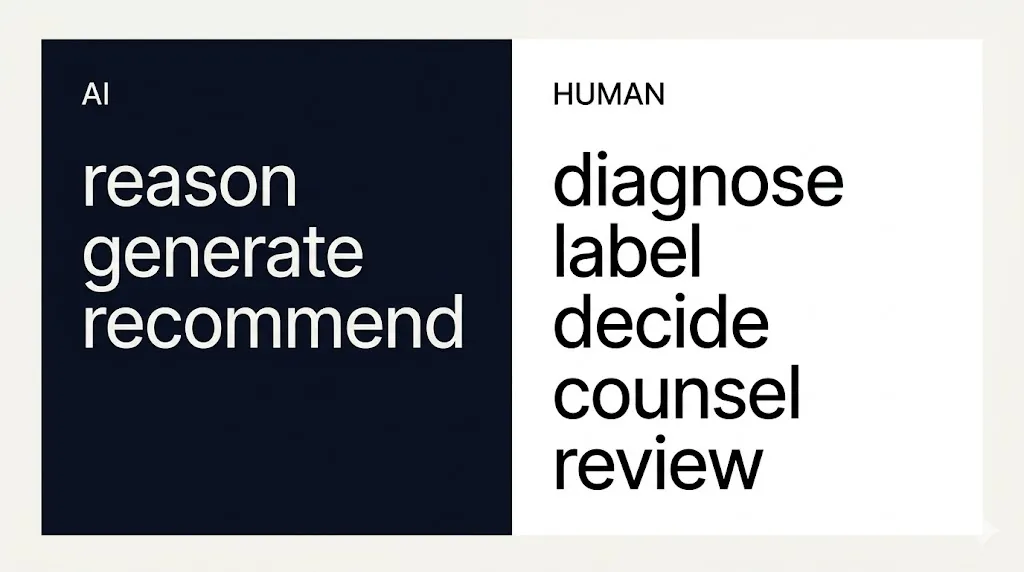
In Sekil.id, our AI reasons, generates, and recommends. But there are things we deliberately keep as human domain. Notes on distinguishing important boundaries from unimportant ones.

Gaffy
Founder & Product Lead
9 min read
When we started building Sekil.id, there was a day when the team sat down and talked about a question that’s probably already in some of your heads.
“Why don’t we just say our AI can do psychoanalysis?”
The question made sense. Investors get more excited about “virtual AI psychologist” than technical descriptions. Press is more interested in big claims. Prospective clients close faster when they believe your AI can do everything.
We didn’t say that in Sekil.id’s copy. Even on the Methodology page, we deliberately wrote an explicit disclaimer:
“AI is not a psychologist. Sekil.id’s assessment results are descriptive and educational. AI only assists with scoring and template-based narratives that have been validated. For deeper evaluation (diagnostic, therapeutic, clinical intervention), consult a licensed psychologist or psychiatrist.”
That’s a sentence that weakens our sales position. It’s also the decision that’s been hardest to hold.
But before I argue why, I want to clarify one thing that, if I skip, would make me guilty of the same overclaim pattern I’m critiquing in this article.
What Sekil.id’s AI actually does
I’ve read marketing articles from AI startups that say “our AI only does scoring and narrative generation.” After looking at their product, the AI does much more complex reasoning. The “just scoring” claim is marketing-friendly but a lie.
I’m not going to do that here.
The AI in Sekil.id does the following:
Scoring and data aggregation. Based on algorithms designed by the methodology team. The algorithms aren’t AI output — they’re human output by people who understand psychometrics. The AI executes those algorithms.
Reasoning from input combinations. When a user selects fields of interest (multi-select), skills they want to develop, work motivations, and provides a 5-year vision in free text, the AI reasons across all those inputs to identify patterns. That’s not simple template-matching. It’s reasoning.
Personalized report generation. The AI assembles reports that include: a narrative profile summary, identification of interest fields (as tags), 4 recommended potential professions with reasoning, lists of relevant technical vs non-technical skills, a personal 4-step career roadmap, and specific certification recommendations.
Contextual recommendations. The AI recommends specific professions (e.g., “Digital Marketing Specialist/Strategist”, “Brand Manager”, “UI/UX Designer”) and specific certifications (e.g., “Meta Certified Digital Marketing Associate”, “Adobe Certified Professional”, “PMI Project Management Ready”). These recommendations don’t come from a fixed template — the AI reasons across user input combinations to surface relevant recommendations.
Anomaly detection. If someone checks “strongly agree” on many questions in a row, or if there’s a suspicious answer pattern, the AI flags it. The AI doesn’t decide the result is invalid — it just sends a signal to a human for review.
That’s a more honest list of what the AI does than “just 4 things.” Sekil.id’s AI reasons, generates, and recommends. That’s substantial work.
What the AI doesn’t do, and why that matters
Now I can argue about restraint from a position that stands on its own feet.
Sekil.id’s AI doesn’t do the following, and each “doesn’t” has a specific reason:
The AI doesn’t do clinical diagnosis. Because psychological diagnosis requires context that can’t be captured through a 30-minute assessment — life history, long-term behavioral observation, ethical judgment about labeling. That’s done by licensed psychologists or psychiatrists, with our assessments as one of their inputs — not as their substitute.
The AI doesn’t assign definitive personality labels. Because personality instruments have moderate test-retest reliability (especially MBTI-style typing) — many people get different results within weeks. Definitive labels would encourage users to internalize identities that are actually exploratory. The explicit disclaimer on our Methodology page: “Results should be used as discussion and self-exploration points, not as permanent labels.”
The AI doesn’t make final decisions about job fit. The AI recommends professions consistent with a profile — but hiring decisions, rejections, or career changes are human decisions that must consider contexts the AI has no access to: specific organizational culture, team dynamics, family expectations, the user’s economic situation.
The AI doesn’t replace career counseling. Even after a user gets a complete assessment result, we still recommend they discuss with a career counselor, mentor, or school guidance counselor. Not as a formality — but because interpretation and execution of recommendations require personal context the AI doesn’t know.
The AI doesn’t self-review its own methodology. Quarterly review of content, item bank, and algorithms is done by the UNJANI Faculty of Psychology team. The AI has no authority to modify itself.
See the pattern?
What the AI doesn’t do isn’t “small things” that are easy to restrain. What the AI doesn’t do are things whose consequences would be biggest if wrong: diagnosis, permanent labels, hiring decisions, replacing human judgment in moments that require context.
Meaningful restraint isn’t “the AI does little.” Meaningful restraint is “the AI doesn’t do things where mistakes would have consequences we can’t absorb.”
Why this division is hard to hold
I’ll be honest about the temptation.
Every time we pitch Sekil.id to investors, there’s a moment where I want to say “our AI can predict the right career for your students.” Not because I want to lie. Because I want them excited. Because I know big claims are more shareable on Twitter than accurate claims.
Every time we discuss with institutional prospects, there’s a moment when they ask “can your AI replace career counseling from school guidance counselors?” The answer that would close them faster is “yes, our AI is more scalable and objective.” The actual answer is “no — our AI augments the counseling process, and in some cases exposes things counselors might not have the bandwidth to explore. But we don’t replace counselors.”
We hold the actual answer. Not because we’re heroes. Because we’ve seen what happens to AI startups that overclaim.
They close deals faster in year one. They raise more in their Series A. But in year two, when clients use the product in real conditions and find limitations that were never disclosed in the sales call, trust collapses. Renewals drop. Refund requests come in. The reputation built on claims starts being attacked with criticism.
For low-stakes products, that pattern can be absorbed. For psychological assessments used by schools, universities, and companies for student career decisions or employee evaluations, that pattern is fatal.
If we claim Sekil.id’s AI can “replace career counseling,” then a school uses the results to determine a student’s major without discussion with a human counselor, and that decision turns out wrong because the AI didn’t have context on the student’s family culture or current emotional dynamics — who’s responsible? Us? The AI? Nobody.
Restraint in Sekil.id isn’t moral grandstanding. It’s an engineering decision aware of the stakes.
A strategy harder to sell, but harder to fake
There’s something interesting about products built with honest restraint. Competitors who overclaim can outpace you in the sales cycle. But they can’t replicate the trust you build.
Competitors can duplicate your features in 6 months. Competitors can hire your engineers with 2x offers. Competitors can copy your copy word for word.
What they can’t duplicate: the track record of consistency between what you promise, what you actually do, and what you publicly acknowledge you don’t do. That triple consistency is built slowly.
For Sekil.id, we’re just starting to build that track record. There’s no public proof yet that our restraint pays off. It’ll take time, maybe 3-5 years, before data supports or refutes this decision.
But we’re confident. Not from a clean business case. From our experience on the other side of the sales table before we built Dartstudio. Most of our partners spent over a decade working on tech projects in companies that bought AI tools from vendors who overclaimed. We saw what happened 12 months later. We won’t be that vendor.
Implications for you
I’m writing this for founders and decision-makers building AI products in high-stakes domains. Medical AI. Legal AI. Educational AI. HR tech. Financial advisory. Anything whose output will be used for decisions affecting people’s lives.
Some questions worth sitting with:
Does your product’s marketing accurately describe what your AI actually does? Not “our AI only does scoring” (which is usually a lie), but an honest description of the reasoning, generation, and recommendations your AI performs. Sophisticated readers will immediately see the gap between claim and substance.
Do you have a specific answer about what your AI doesn’t do, and why? If the answer is generic (“our AI doesn’t do diagnosis”), dig deeper: why not? What consequences are you avoiding by not doing that? Mature vendors have specific answers to this question. Immature vendors have disclaimers that sound nice but have no substance.
Are the boundaries you hold the important boundaries — boundaries where mistakes would have serious consequences — or just boundaries that are easy to restrain because your AI can’t actually do them? The most credible restraint claims come from products that could do more but deliberately don’t. Restraint claims from products whose capabilities are simply limited is fabrication.
Are you willing to lose deals because you’re honest about the boundaries you hold? If the answer is “no,” you’ll slowly be pulled toward overclaiming. That pull doesn’t happen at once. It’s one extra sentence in the pitch deck, one new adjective in hero copy, one disclaimer moved to the FAQ. Until the accumulation becomes a product you no longer recognize.
Closing
I’ll close with one observation.
In Indonesia, many young founders enthusiastic about AI are aggressively building products in high-stakes domains. Medical AI. Edutech claiming to “personalize learning.” HR tech claiming AI can determine who fits which hire. I know several of them personally. I know they have good intentions.
But I also know that some of their claims exceed what their products can actually do. Not because they lie. Because Indonesia’s startup ecosystem rewards big claims faster than accurate claims. Investors want bombastic TAM. Media needs a clickable angle. Institutional clients are limited in their ability to evaluate.
Sekil.id is our attempt to stand slightly against that current. Not with “our AI restrains” claims that are easily faked. But with the practice of distinguishing important boundaries from unimportant ones — and being public about both.
If three years from now there are more AI vendors in Indonesia who dare to publish what their AI does and doesn’t do specifically, we’ll feel Sekil.id has succeeded. Even if Sekil.id itself isn’t market-dominant yet.
That’s a definition of winning no marketing book would agree with. But it’s the definition of winning that matches why we built Sekil.id in the first place.